°
Temperature regulation
Water helps your body maintain its temperature. Heat and activity can increase the fluid you lose.
CDC / Water & health ↗A familiar source. A portable ritual.
A closer look at hydration.
Hydration is part of the everyday work of being human. Not a performance hack. Maintenance.
Water helps your body maintain its temperature. Heat and activity can increase the fluid you lose.
CDC / Water & health ↗Electrolytes carry electrical charges in body fluids and help regulate the amount of water in your body.
NLM / Electrolyte balance ↗Minerals including sodium and potassium help nerves and muscles function. You get them from food and drinks.
NLM / Electrolyte balance ↗Explore what water and electrolytes do inside the body. Tap an element.
Drinking fluids replaces water lost through everyday processes, including sweating and urination. Food also contributes to your daily water intake.
Your needs change with activity, climate and life stage. There is no single daily volume that fits everyone.
CDC / Read the source ↗Sodium is the main electrolyte in the fluid outside your cells. It helps regulate blood volume and how much water the body holds on to.
Most people get more than enough from food. In long or hot exercise, sodium lost in sweat is the electrolyte rehydration research pays most attention to.
NLM / Electrolyte balance ↗Potassium is the main electrolyte inside cells. It works with sodium to carry the electrical signals that let nerves fire and muscles contract, including the heart.
Coconut water is naturally rich in potassium. That does not make it a substitute for sodium; the two have different jobs.
NLM / Electrolyte balance ↗Magnesium takes part in hundreds of enzyme reactions, including the ones that produce energy in muscle and keep nerve signalling steady.
It is present in coconut water in smaller amounts than potassium. Food remains the primary source for most people.
NLM / Electrolyte balance ↗These are roles of nutrients in human physiology, not measured benefits or nutrient amounts for COCO:ION.
A naturally interesting starting point.
Coconut water contains naturally occurring sugars and minerals, including potassium. Its composition varies with the coconut and how it is processed.
It has been studied as a rehydration drink after exercise. Small trials suggest it can contribute to rehydration, but they do not establish that it works better than water for everyone.
Coconut water generally contains less sodium than many sports drinks. Potassium and sodium have different roles; one does not replace the other.
Reference composition / plain coconut water, per 240 ml
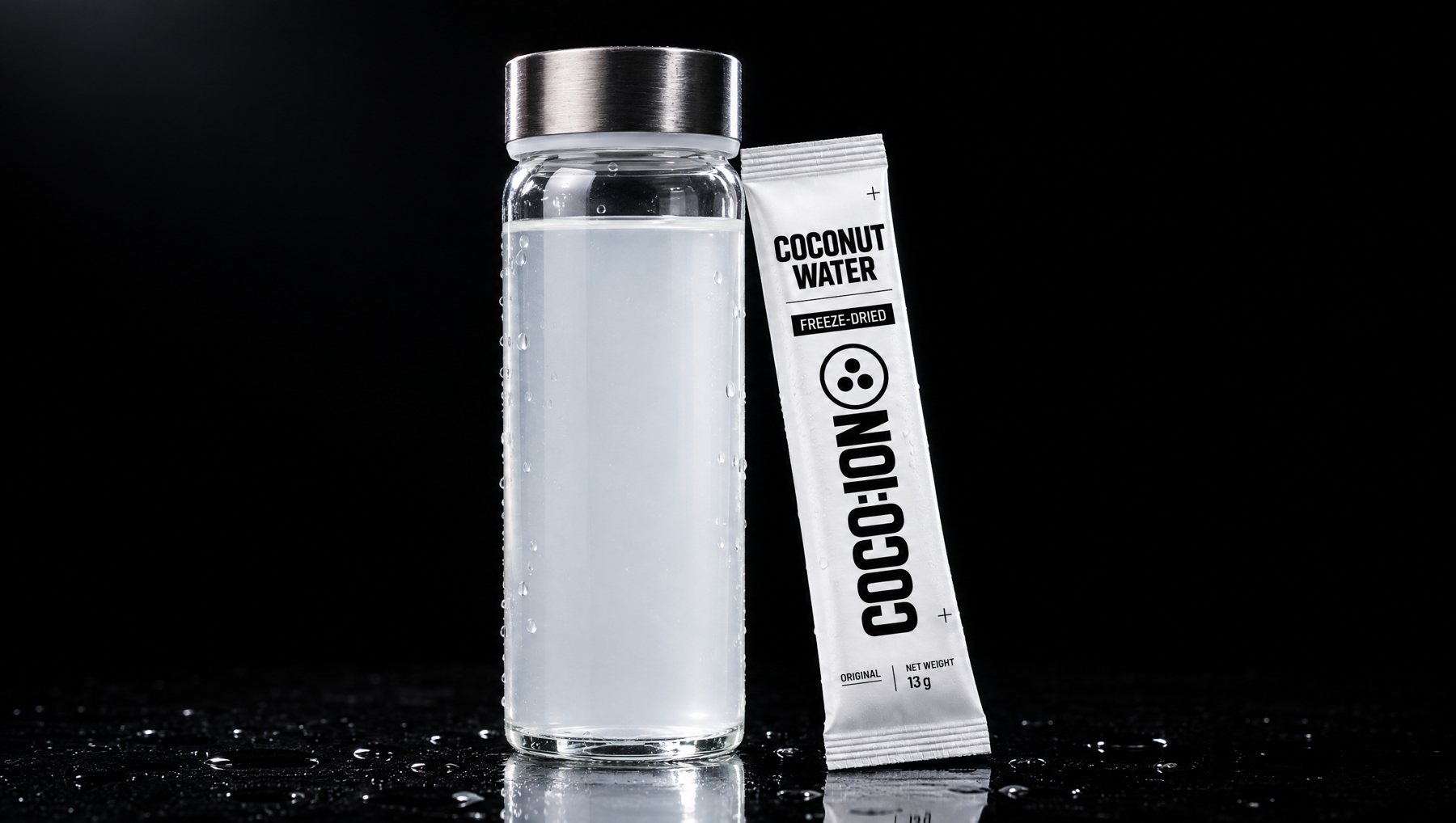
Our mark. Its natural signature: the three eyes of the coconut, in glass.
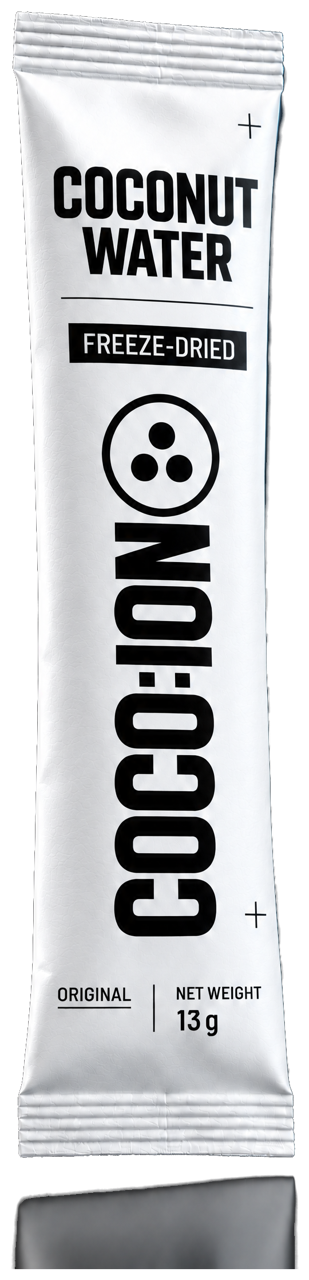
A matte-white stick. A clear purpose. Coconut water in a format designed to travel with you.
In development. Final ingredients, nutrition, processing method and mixing directions will be published once verified.
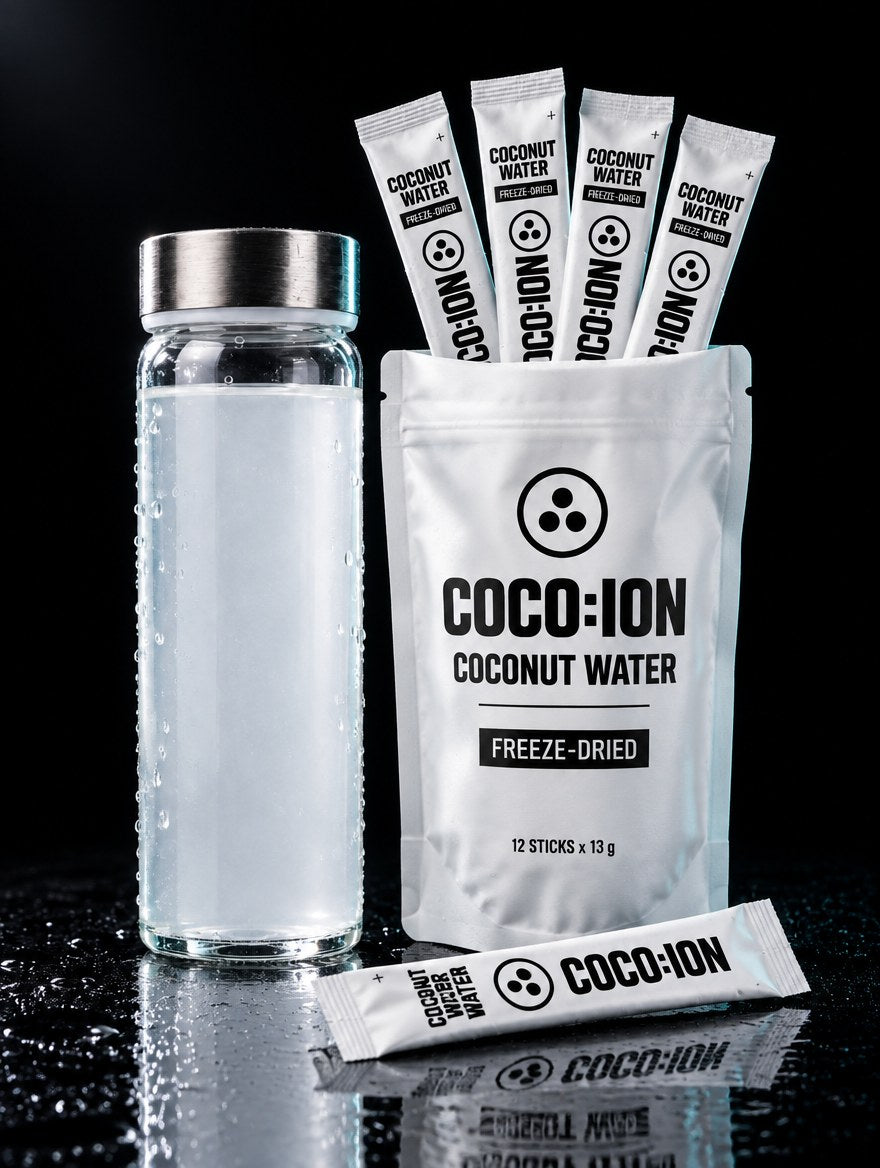
Water and regular meals form the foundation of everyday hydration. Coconut water can add variety to what you drink; you do not need an electrolyte drink every time you feel thirsty.
CDC / Everyday fluid intake ↗During sweaty exercise you lose water and, with it, electrolytes, sodium most of all. For sessions under an hour, water is usually enough. Beyond that, or in heat, a drink with some sodium and carbohydrate has the most evidence behind it.
Ismail et al. / Sodium and rehydration ↗After activity the aim is to replace what you lost, and small trials have found coconut water rehydrates about as well as water or a sports drink in that window. Its lower sodium is the reason it does not clearly beat either.
Kalman et al. / Post-exercise trial ↗Freeze-drying removes water from a frozen material under vacuum. Here is the process behind the proposed format.
The material is frozen before drying. The water inside becomes ice, ready for removal under reduced pressure.
Process reference / FDA ↗Under vacuum, ice sublimates straight to vapour without melting. What stays behind keeps the shape of the frozen structure: a light, porous solid that rehydrates quickly.
Process reference / FDA ↗The powder is milled, weighed into sticks and sealed. When it meets water, the porous structure wets through and dissolves in seconds.
See the ritual ↗Process illustration. Our supplier's freeze-drying method and the finished formula still require confirmation. Drying alone does not establish nutrient retention.
One stick, one bottle of water, a few seconds of shaking. No measuring, no refrigeration, no carton to carry home.
 01 / Tear
Open the stick at the notch and empty the powder into 240 ml (8 oz) of cold water. Up to 330 ml if you like it lighter.
Cap and shake for a few seconds. Freeze-dried powder wets through quickly because the porous structure pulls water in.
It turns faintly cloudy, the way water from a young coconut does, not clear like a sports drink. That haze is the coconut solids coming back.
Mixing directions are provisional. Final ratios will be published once the formula is confirmed.
Shaker, squeeze bottle, soft flask, a glass from the cupboard. Whatever you already drink from, and eight ounces of water.
Coconut water is one of the oldest drinks people reach for when they are hot and tired. We wanted the same source, without the shell, the carton or the fridge.
COCO:ION started in Southeast Asia, where a coconut is something you drink on the street, cold and opened in front of you. It does not travel well. Cartons add weight, shelf-stable versions are often heat-treated, and both go flat in taste.
Freeze-drying turned out to be the interesting answer. Freeze the liquid, remove the water under vacuum, and you are left with a light powder that carries the mineral profile of what it came from. Add water back and it is ready.
We are a small team with a packaging and processing background, not a supplement company. That shapes how we talk about the product. We publish what we can verify, we cite studies with their limitations attached, and we say plainly when something is still in development.
The three dots in our mark are the three germination pores of a coconut, the eyes you tap through to drink it. One origin, every stick.
Every claim on this site links to where it came from, including the ones that cut against us.
One ingredient direction, one flavor, a white pack. The product has to hold up on its own.
Where the formula, nutrition or process is unconfirmed, the page says so instead of rounding up.
Start with the findings. Keep the limitations in view. None of these trials tested COCO:ION.
In 12 exercise-trained men, bottled water, two coconut-water drinks and a carbohydrate-electrolyte sports drink produced broadly similar rehydration and treadmill time-to-exhaustion after about 2% body-mass loss. The coconut-water conditions caused more bloating and stomach upset, likely because more than two litres were consumed within an hour.
Small sample; specific exercise conditions; modest dehydration. The trial did not test COCO:ION.
Kalman et al. / Read the study ↗Ten healthy men exercised to about 3% body-mass loss, then rehydrated with plain water, a sports drink, fresh young coconut water, or coconut water with added sodium. Two hours later, rehydration indices were 58% for water, 65% for coconut water, 68% for the sports drink and 69% for sodium-enriched coconut water, with better fluid tolerance for the coconut-water drinks.
Ten participants, all still somewhat dehydrated at two hours. The result points at sodium, not coconut, as the variable that moved the number.
Ismail, Singh & Sirisinghe / Read the study ↗Eight recreational athletes cycled for an hour at 70% VO₂max, then drank 150% of the fluid they lost as flavored water, coconut water or a carbohydrate-electrolyte drink. Flavored water produced the most urine. Fluid retention was highest with coconut water, but not statistically different from the sports drink, and all three rehydrated participants to a comparable degree.
Eight participants, a two-hour window and no urine specific gravity measures. Promising findings, small evidence base.
Bell & Spriet / Read the manuscript ↗The newest trial in this area compares plain water, a sodium-potassium solution and a potassium-rich solution for fluid balance and thermal strain after exercise in the heat. It is published ahead of print in the International Journal of Sport Nutrition and Exercise Metabolism and speaks to the question coconut water raises: what does a drink that is high in potassium and low in sodium actually do for recovery?
Ahead of print. We link the abstract and will summarise the findings here once we have read the full paper.
IJSNEM 2026 / Read the abstract ↗Not for everyday hydration. Mayo Clinic's view is that coconut water is no more hydrating than plain water, and the trials above mostly found it comparable to water and sports drinks. Its interest is what it contains alongside the water: potassium, some sodium and magnesium, and a taste people like enough to keep drinking.
We will publish the figure once the finished formula has been lab-tested. As a reference, plain coconut water carries about 600 mg of potassium per 240 ml according to USDA data, and freeze-drying removes water rather than minerals. The actual amount depends on the source coconuts and the processing, so we are not quoting a number we cannot yet stand behind.
No. Coconut water contains naturally occurring sugars, roughly 6 g per 240 ml in the USDA reference, and those concentrate into the powder along with the minerals. The Original direction has no added sugar. Exact figures per stick will follow the final nutrition panel.
Because it is coconut water. Water from a young coconut is never fully clear; it carries fine solids that scatter light. When the powder dissolves, those come back, so the drink turns faintly hazy rather than glassy. Shake, and it settles into an even, light cloud.
A coconut has three germination pores at its top, often called eyes. One of them is soft enough to push a straw through. The mark is those three eyes inside the shell: three points, one origin.
Spray-drying uses hot air, freeze-drying uses cold and vacuum. We chose the freeze-dried direction for taste and because it avoids high heat, though we do not claim a nutrient-retention advantage until our supplier's process and our own testing confirm one.
Not yet. The stick is in development. Join the list below and we will tell you when the first run is available, and what is in it.
First run
Leave an email. We will write once when the first sticks are ready, with the full nutrition panel attached.
No newsletters, no sharing of your address.